
Advanced English Writing Tutor | British English lessons & Accent reduction
Native English ESOL Tutor - Advanced English writing coaching for ambitious international students and professionals
Already speak English well? Learn to write English with clarity, confidence and sophistication
Getting to Know Each Other


How I can help you
Contact Me

Getting to Know Each Other

My name is Phil, an online advanced English writing coach, born and raised in Birmingham, UK. I currently share my time between the UK and the beautiful town of Sulmona in Italy. I am a trained teacher who has spent 20 years working in numerous educational settings, helping to shape the lives of learners from all over the world. I have a passion for languages and having studied Italian and Farsi for a number of years, I am entirely familiar with the struggles a language learner may encounter.My teaching has been shaped by my love of literature and this can form a part of our lessons, or even a starting point for our lessons should this be an area of interest. Whilst focussing largely on the writing process, I also specialise in accent reduction and in providing a safe and effective space for developing your conversational skills.You can view the lesson options by accessing my calendly page. Should you wish, you will also be able to access resources such as the 'Write-On-Track' course and the 'Accent Reduction Pack'.
How I can help you

Do you wish to master the English skills that schools, universities and employers expect? Check out my blog posts for IELTS guidance!
Have you recently moved to/or planning to start a new life in an English Speaking Country?
Are you learning English for pleasure and wish to improve your writing skills?
Do you have a passion for literature but don't know where to start with English Literature?
Are you looking to reduce your accent and speak a more natural style of British English?If one of the above applies to you (or if you simply wish to develop your conversational skills), by following the link to my calendly page, you will be able to select the lesson that is right for you!
Contact Me

For further information, feel free to contact me via WhatsApp:
+44(0)797 5987108
or email:
[email protected]Should you wish to book your free 30 minute lesson, please access my calendly page:
www.calendly.com/teacherpdbPerhaps you would prefer a face-to-face lesson. I would be happy to arrange this for individuals living within or close to the Birmingham area.
Blog#1 - Should my language teacher be a native speaker or someone who speaks my own language?

26 June 2026Since I started on my own language learning adventures approximately a decade ago, a question I have been continuously asking myself (particularly in the early stages when I was choosing my first tutor), is should I be learning from a native speaker or someone who speaks my own language?It is a question that crops up all the time when reading comments on language learning forums or when scanning YouTube and various other platforms for new and interesting language content.The answers vary. Some are adamant that it needs to be a native speaker, or how else will you truly replicate the nuances of your target language?Others will argue that if you are encountering a particular difficulty over a grammar point or a structure that doesn’t exist in your own language, how can this be explained to you clearly and fully by someone who doesn’t speak your language? A compatriot, surely, having faced the same difficulties in their own language learning journey some years earlier, are best placed to explain, in the clearest possible terms, how to overcome these barriers.So, should I go native or stick with the familiar?By sharing with you a particular difficulty I encountered when learning Italian a few years ago, will, I hope, illustrate the point a little more clearly. I would like you to consider the following phrase, written in the present perfect progressive tense:I have been learning Italian for 2 yearsI remember all to well those extremely uncomfortable conversations in the early days. I felt that I was ready to start conversing freely with Italians, however, as occurs to us all, I was paralysed with fear when the moment arrived to open my mouth. One particular structure was my nemesis. A local would ask me for how long I had been learning Italian and, thinking with my English hat on, I wanted to respond 'I have been learning Italian for 2 years'. So many sentences in English, it seemed to me, were constructed using the present perfect progressive and I wanted to directly translate this to my Italian!!!It has been raining for over a month now
He has been waiting there for at least an hourLet’s break this down - I have been learning Italian for 2 years
I (subject)
have been (present perfect auxiliary)
learning (present participle)What does this mean?
It started in the past
Has continued up to the present
May still be continuing nowI encountered all manner of problems when trying to express sentences of this kind in Italian because a very different structure exists.In Italian it would be most naturally translated to:
Studio Italiano da 2 anni‘Studio’ is the present indicative of the verb ‘to study’So in short, in Italian, to express an action that started in the past and is continuing now, you would use the present indicative + da (to then indicate the length of time).
Whilst a progressive tense does exist in Italian, there is no direct equivalent to the present perfect progressive.This I am sure would create similar levels of confusion for an Italian learning English as it did for me learning Italian.For those of you learning English, consider these two sentences:He has been a teacher for 20 years
They have been to RomeThese sentences are in the present perfect tense rather than the present perfect progressive, however, I have selected them because they present an interesting point of discussion (and confusion) for someone learning English.Both of these sentences are, I am sure you will agree, examples of the present perfect tense that include the verb ‘to be’. Therefore, they contain ‘has been/have been’ within them, as ‘been’ is the past participle of the verb ‘to be’.For the first example ‘He has been a teacher for 20 years’ it all seems reasonably clear. As an English student, you have arranged the sentence in your head (in your native language) and you start to construct it in English by applying the necessary grammatical rules and correctly conjugating the verb ‘to be’. It is immediately clear to you that the verb ‘to be’ is the verb that you need!Look at the second example ‘They have been to Rome’. When preparing the sentence in your head, prior to translating it into English, you feel sure that you will need to verb ‘to go’ or ‘to stay’!!! Unfortunately, in this example, the verb ‘to be’ is being used in an idiomatic expression.And English does this to us time and time again. And it is true of other languages too! There is always an exception to the rule, always another potential barrier to our understanding.So to return to my original question, who is best placed to explain to the learner all of these exceptions that exist within our target language? Certainly, if you are at the early stages of learning a language, someone who could explain to you in your own language exactly how it all works (the grammatical conventions/the exceptions to the rule etc.) would be beneficial. Perhaps, more importantly, somebody who speaks your language would also be able to anticipate such problems before they even strike you as being a problem. Remember, they too have trodden the same path as you are now taking!!So where does this leave the native speaker?The single, most valuable quality that the native teacher possesses, is in fact, the very opposite of that which I have just identified as being the greatest strength of the non-native teacher. The native teacher perhaps won’t be able to identify all of the potential misunderstandings you may have as a learner of their language, but the beauty is, they will provide you with a continuous stream of vocabulary and sentence structures (idiomatic or otherwise) in a completely natural and authentic way, without it ever being forced. The secret is, however, to not waste weeks and even months listening to such authentic input from your native tutor, without completely understanding what it represents.So what is the answer?In short, my experience of language learning has taught me that, from the outset, it is beneficial to have 2 teachers. One of them being a native speaker and the other, someone who speaks my own language. Obviously, the latter will be able to speak my target language to a very high standard.This is something I didn’t do when I first started to learn Italian, and I wasted a lot of time following the well-intentioned advice of ‘expose yourself to as much comprehensible input as possible’. This was of course hugely beneficial, but by doing this I was seeing and hearing a lot of expressions and grammatical idiosyncrasies that I thought I was understanding, but the reality was, I was only understanding them in a passive manner within the wider context. Great for developing my listening skills but less so for when I needed to speak in Italian myself.To this you might very well say, well weren’t you studying Italian grammar? Yes, I was, but there would often be things that didn't make sense to me. When asking for clarification from my native Italian teacher, in some instances, her explanation of the concept didn't quite resolve the problem. They didn’t address the doubts and uncertainties that existed in my head. An English speaking head complete with my own linguistic biases and limitations!Of course this may not be true for everyone, and I know many people who insist on learning exclusively from a native speaker. Everyone must find the approach that works best for them. What I am now doing with Farsi (and again should I look to take on any new languages in the future), is to have both a native teacher and someone who speaks my own language. The latter can both explain and, more importantly, anticipate the problems I am likely to encounter, thus allowing me to fully maximise the benefit of then working alongside a native speaker.I’m sure, like me, you’ve found in the past that the most effective way for a concept or new vocabulary ‘to stick’, is when it has been introduced to you in one particular setting and then, suddenly, it presents itself to you in a new setting. It’s like the reappearance of a long-lost friend in very pleasing circumstances. It sticks! Such eureka moments, I find, are far less frequent when conversing with just one person. They may have repeated the same concept for the umpteenth time or you may have poured over your notebook of ‘important things to remember’ relentlessly, only to find it is still a little out of reach. Multiple teachers, with different linguistic backgrounds and outlooks, can be combined by you the learner, to target your needs and maximise those ‘eureka’ moments!As I have said, a language learning journey looks different for everyone and there are many different factors that need to be considered, not least our own personal learning style. But for me, I am a strong advocate of the two-teacher-approach, as the benefits are many in terms of minimising the frustrations we all encounter on our language journey.
Blog#2 - IELTS Writing Task 1 - How do I show off my English proficiency?

11 August 2026When responding to the IELTS writing tasks, the temptation is to shoehorn in an array of sophisticated words and expressions so as to showcase your command of the English language. As a native speaker/writer of English, whilst I possess that inherent appreciation of what the situation demands, I still have a number of stock expressions/turns of phrase that I look to weave into my writing (you will note that I underlined ‘so as to’ a little earlier - a particular favourite of mine as a means of expressing purpose) as well as a clutch of ‘fancy’ sounding words. That said, the advantage I and other native speakers of the language possess, is the instinct to know when it is becoming ‘too much’. In other words, knowing when the addition of a novel ‘turn of phrase’ or an abstruse vocabulary choice begins to feel unnatural and so has the effect of detracting from the message that is to be conveyed.In your IELTS writing task, to possess such an awareness is critical, as you have so few words to play with. So you may be asking ‘how do I show off my command of the English language whilst still effectively answering the question? As far as the IELTS writing task 1 goes, it is a case of being a little more subtle. Showing off your English language skills isn’t always about ‘flowery’ language and complex sentence structures.One term you will hear many people refer to when offering advice on structuring your IELTS writing tasks (or any form of academic writing) is that of ‘cohesion’. And rightly so! Without it, one’s writing meanders aimlessly.The IELTS writing task 1 is absolutely about reporting information, not presenting personal opinion. Moreover, there is a logical progression to follow (a template almost) so as to respond to the question concisely and effectively. The use of cohesive devices here is critical in steering your way through your response and staying within the word count.Essentially, IELTS writing task 1 requires you to (within 150 words):1. Provide an overview of the ‘big picture’
2. Move onto describing the two or three most significant trends or comparisonsThe scope here for developing arguments or showing off the depth of you vocabulary bank is minimal. The key is to achieve cohesion: making reference to the key points that have been represented in graphical/pictorial form and translating it into a progression of logical sentences. It is a somewhat formulaic process!Take a look at the following example of an IELTS writing task 1:
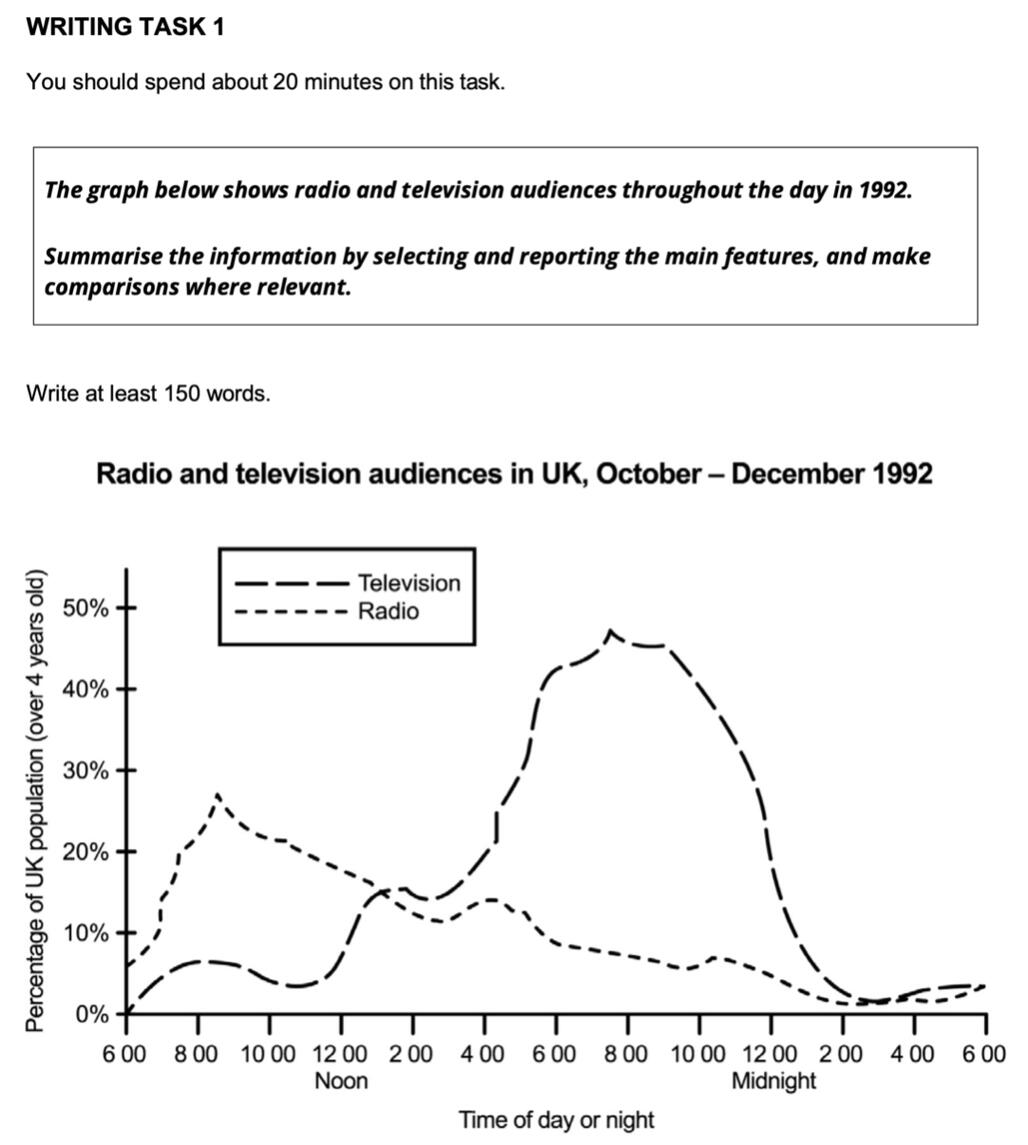
And this is where the deployment of effective and, more importantly, natural sounding cohesive devices will guide you through the process.
So what are the cohesive devices we should be looking out for?1. Conjunctions/Linking words: furthermore, moreover, although, whereas, therefore, consequently, first, finally
2. Pronouns/Reference words: he, it, those
3. Repetition of key words
4. Synonyms and related words: i.e. car/vehicle
5. Substitution: i.e. “I prefer the red dress. The blue one is too bright.”
6. Ellipsis: leaving out words that are understood from the context i.e. John likes football, and Mary does too.
7. Lexical cohesion: using words from the same topic or semantic field i.e. The teacher entered the classroom. The students opened their books.
8. Adverbials/Transition signals: show relationships between ideas, i.e. meanwhile, as a result, on the other hand, for exampleHow, you might be asking, can we apply these devices to our writing?I have set out below PART of a response to the above task.At 6:00am, around 5% of the population listened to the radio, compared with almost no television viewers. Radio listenership then rose sharply, reaching about 20% at 7:00am and a peak of roughly 27% at 8:00am. After this point, the figure declined gradually throughout the morning, falling to approximately 15% by midday. It remained at around 10-15% during the early afternoon before decreasing steadily to below 10% after 6:00pm. By midnight, only about 2-3% of people were listening to the radio.When analysing this, we would be mostly looking at the sentence openers as a means of deploying our cohesive devices (but not exclusively). You will note that I have colour marked the areas of interest.I would particularly like to focus on the words marked in blue, which is an effective example of using synonyms/related words (No.4). This avoids repetition of the word ‘population’ throughout the paragraph. A similar thing is achieved when the term ‘Radio listenership’ is replaced by the pronoun ‘It’.As for the parts marked in red, see if you can decide the particular type of cohesive device they each represent.It is worth mentioning that the model answer doesn’t rely too heavily on obvious liking words such as furthermore, however etc. Instead it achieves cohesion through a combination of time connectives, comparison, conjunctions and sequencing. This achieves a more natural feel than trying to force a linking word into every sentence.To return to the point I was making earlier, think of the IELTS writing task 1 as something that requires a more mathematical/analytical turn of mind, so as to extract and mentally order the key points contained within the graph/chart. Continuing with the structured approach, these points can be dropped into your writing template: a template that can be applied for any writing task 1 question. Where you will be looking to ‘add value’, will be largely through the effective use of cohesive devices as discussed above.Of course, it is not simply a case of cohesive devices being the ‘be-all and end-all’! An effective piece of writing is the culmination of many skills being applied simultaneously. In my next blog, I would like to address how verb choices and their accompanying adverbs can also help engage the reader and elevate one’s writing, particularly in relation to the writing task 1.